
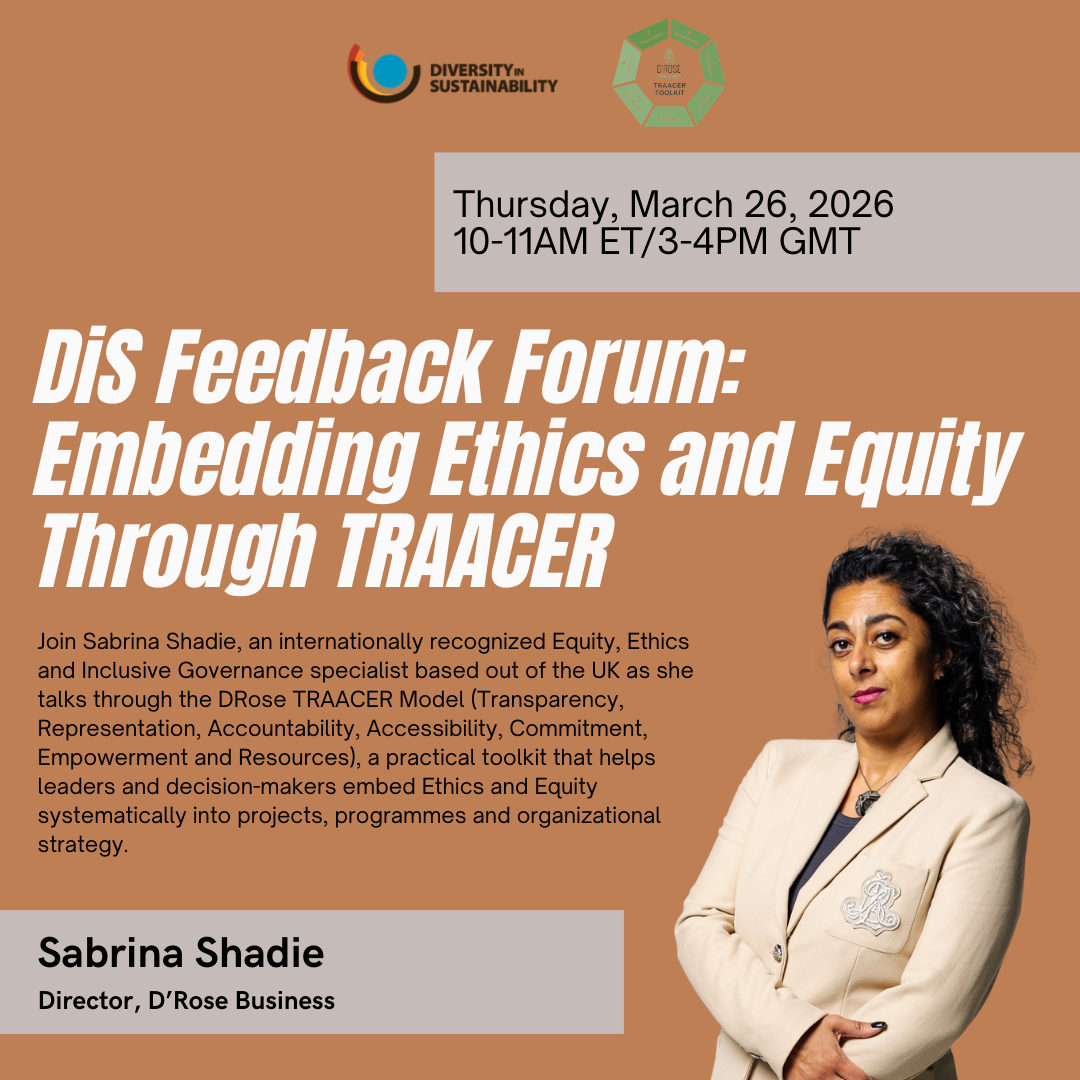
DiS Feedback Forum: Embedding Ethics and Equity through TRAACER
DiS Feedback Forum is a collaborative session where DiS community members share projects in progress and receive constructive input. Participants gain fresh insights, sharpen their ideas and expand their network along the way.
Join Sabrina Shadie, an internationally recognized Equity, Ethics and Inclusive Governance specialist based out of the UK as she talks through the DRose TRAACER Model (Transparency, Representation, Accountability, Accessibility, Commitment, Empowerment and Resources), a practical toolkit that helps leaders and decision-makers embed Ethics and Equity systematically into projects, programmes and organizational strategy. It simplifies complex Social Impact concepts into actionable steps and reflective questions so teams can check that planning, delivery and evaluation are genuinely inclusive and ethically aligned. In the discussion, Sabrina will walk through the seven principles, reflective questions and scoring approach and invite feedback on where the model best supports your work and how it can be strengthened further. In particular, she welcomes insight on reinforcing sustainability-aligned governance within TRAACER so that ethical, inclusive decision‑making and resource allocation are consistently geared towards long‑term, equitable outcomes.
About Sabrina and D Rose
Sabrina Shadie is an internationally recognised Equity, Ethics and Inclusive Governance specialist with over 25 years’ experience supporting organisations across the environmental, higher education, health, public and non‑profit sectors to embed meaningful, values‑driven change. A Fellow of both the Institute of Equality & Diversity Professionals and the Institute of Leadership, she brings deep expertise in systems change, intersectional practice, organisational culture, and ethical decision‑making.
Sabrina’s work is informed by lived experience of intersecting inequalities, shaping a practice that is relational, justice‑focused and grounded in real‑world structural understanding. She has designed nationally recognised race equity programmes, delivered CPD‑accredited anti‑racism and EIA training, and supported sector‑wide initiatives advancing representation, accountability and sustainable inclusion. Her approach combines strategic clarity with practical delivery, enabling organisations to take confident, evidence‑led steps toward equitable, resilient and ethical futures.
About DRose
DRose is a small, values‑led consultancy and learning academy that helps organisations embed Ethics and Equity into everyday strategy and delivery. Through DRose Academy’s CPD‑certified learning and practical toolkits, most notably the TRAACER Toolkit, we turn complex social impact concepts into simple, actionable steps that strengthen transparency, representation, accountability, accessibility, commitment, empowerment and resourcing in real projects. Our work spans leaders and teams across sectors, with reflective assessments, scoring guides and templates that make inclusive practice measurable and repeatable. DRose is a committed signatory of the Disability Confident Scheme, Good Business Charter, Prompt Payment Code, and the Charter for Inclusive Entrepreneurs, reflecting our long‑standing focus on ethical leadership and fair business practice.
About the Drose TRAACER Model
The DRose TRAACER Model is a practical toolkit that helps leaders and decision‑makers embed Ethics and Equity systematically into projects, programmes and organizational strategy. It simplifies complex Social Impact concepts into actionable steps and reflective questions so teams can check that planning, delivery and evaluation are genuinely inclusive and ethically aligned. The model sits within the wider DRose Ethics and Equity Strategic Framework, giving organizations a consistent structure to apply equitable approaches and quality practices across all decision‑making and development processes.
At its core, TRAACER brings focus to seven principles that underpin ethical and inclusive practice:
Transparency, Representation, Accountability, Accessibility, Commitment, Empowerment and Resources. These principles prompt leaders to consider disclosure and trust; who is involved and centred; who is responsible and how they are held to account; how accessible the work is; long‑term commitment to change; empowerment of historically marginalised groups; and whether resources are aligned to inclusive goals.
The toolkit is designed for hands‑on use. Participants apply the framework to their own projects via:
Guided reflection and simple, seven‑question prompts covering decision‑making, planning and implementation;
Introductory0–5 scoring checklist (with justification for each score) to evidence what is working and where gaps remain;
Advanced Excel template and practical resources that support continuous improvement and accountability.
Learning outcomes are CPD Standards Office–certified and include: identifying criteria to measure the impact of diversity actions, implementing good practice and articulating transparency and accountability within inclusive culture change. The training encourages iterative review and documented reflection so teams can track improvement over time and align to organisational objectives.