
DiS Office Hours with Michael Kobori
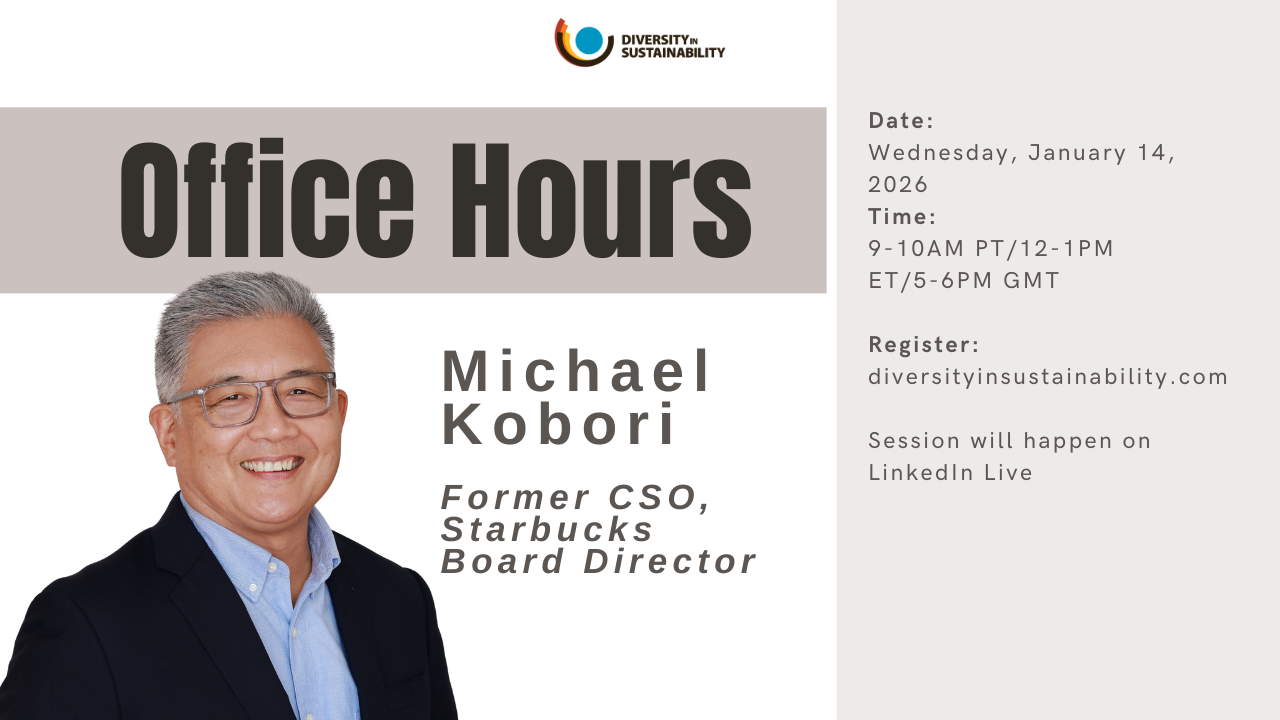
On January 14, Diversity in Sustainability hosted a special livestream Office Hours with Michael Kobori. Michael Kobori has spent his career working to build a more just and sustainable world. He has served as a board director of Bunge Global SA, Chief Sustainability Officer at Starbucks, Vice-President of Sustainability at Levi Strauss & Co., Vice-President at BSR, and in various roles at The Asia Foundation. Currently, he is a strategic advisor to NationSwell, a community of leaders from the corporate, public, and non-profit sectors and an advisor to Gaeastar, a circular economy start-up.
Michael is a member of the U.S.-Japan Council and The Asia Foundation’s President’s Leadership Council. He has served on the USDA’s Cotton Board, UN Better Work Program, the Sustainable Apparel Coalition, Better Cotton Initiative, and the Levi Strauss Foundation board. An esteemed speaker at UN forums, the Aspen Institute, and industry conferences, Michael is dedicated to nurturing the next generation. He taught sustainability at the Haas Business School, University of California at Berkeley and has served as a mentor for 50/50 Women on Boards.
Michael received his Masters’ Degree in Public Policy from the University of California at Berkeley, where he also received his undergraduate education in Asian Studies and Psychology. He spent a year at International Christian University in Tokyo and studied sustainable finance at Oxford University.
Michael is married to Sachiko Nagai. They live in Berkeley, California and have two adult daughters, Anne and Ellen. Michael is an enthusiastic chef and enjoys cycling, fishing, gardening, and swimming. He recently completed his PADI open water scuba diving certification.
Here are some of the highlights of Michael’s discussion with Heather – you can also watch the video here:
Michael is a third generation Japanese American, born and raised in San Jose. Both parents were in Japanese American interment camps during World War II, and their experience helped shape his views on social justice. This underscored the importance of the connection between the environment and people and social justice, and particularly environmental justice. Michael’s father grew up on a farm in central California, and they were sharecroppers – his family was helping to plant and harvest. One of the lessons Michael learned was that in a generation, your family can go from being impoverished sharecroppers to being on the board of one of the largest agricultural companies in the world.
Retirement activities: In his retirement, Michael has been focusing on his own personal, family and friends’ health and well-being. He has also been advising companies and organizations and individuals on sustainability, and learning about private wealth, private equity, private wealth, family offices and how they can support social and environmental justice. Lastly, he has been focused on supporting disruptive startups.
What do you do in a time of disruption? During a time of disruption – with the global backlash against ESG and DEI and limited growth, Michael suggests focusing on where sustainability and business objectives overlap, and will likely be like this for the next 3-5 years.
Working with private wealth and private equity: they are not bound by quarterly results, and have a greater appreciation for climate change, water and waste. Also, the lens of protecting family wealth over the longer term provides a broader view.
How skills have evolved in corporate sustainability: at the start of this field, having technical knowledge on social and environmental and human rights impact was important. That knowledge is now foundational, and the critical piece is to translate this into business results – Michael would suggest that having a deep understanding of finance is powerful. At Starbucks, Michael worked with his supply chain finance team to help them improve cash flow for suppliers by partnering with World Bank and IFC. In addition, at Levi’s he was able to co-develop a program for suppliers to access easier cash flow and preferential interest rates by meeting labor standards and showing progress. He also suggests knowing people in the treasury department to innovate new uses for cash, such as creating low interest loans with non-profit organizations.
Change management in large organizations: Michael’s focus has always been on having sustainability as a competitive advantage, in a system that is more sustainable and respectful of justice. He has found that understanding company culture is the most important thing – at Levi’s he found it to be creative, and he appealed to his colleagues with that. His will help you to understand what information, data and arguments you have to present to do something differently.
Influence in large organizations: Michael suggests that to be a successful sustainability leader you have to have passion, patience, perseverance and practicality. He also suggests that you have to have charm, to persuade people to like you and want to work and follow you. In terms of figuring out who to use charm with – look at where your biggest impacts are through a “materiality analysis”, and get to know that team better.
When corporate goals are at odds with sustainability ambition: Michael suggests looking at the intersection of the goals and ambition – but also stepping back to understand that if you work at a company, their function is to make a profit and not necessarily to meet Paris targets.
Threats: AI is a big threat and opportunity. The changing global marketplace as a reaction to the inability of globalization to deliver equitable benefits to people in different countries around the world, leading to extreme political movements, tariff and non-tariff barriers, an inability to travel and ship, also leading to reduced demand.
Acting alone vs. together: Michael believes we must continue to work together on collective issues to share cost and spread risk and make more progress.
Reaching sustainability with the realities of consumer convenience, consumption patterns and financial expectations: Michael gave the example of the work that Gaeastar was doing with ceramics and packaging to automate and local production to reduce shipping costs and create local employment without having to pay for disposable cups or containers.
Role of university enterprise partnerships for advancing sustainability outcomes: Michael alluded to longstanding partnership with Arizona State University to provide online bachelor’s degree programs to any barista free of charge, and over 15 years, 10,000 baristas received their degree through the program. Michael believes that universities are great at R&D, thinking long-term, and being interdisciplinary.
Recommendations for the future: don’t be afraid to explore, think disruptively and go where there is innovation or dynamism happening. Don’t also hesitate to reach out to people for advice.